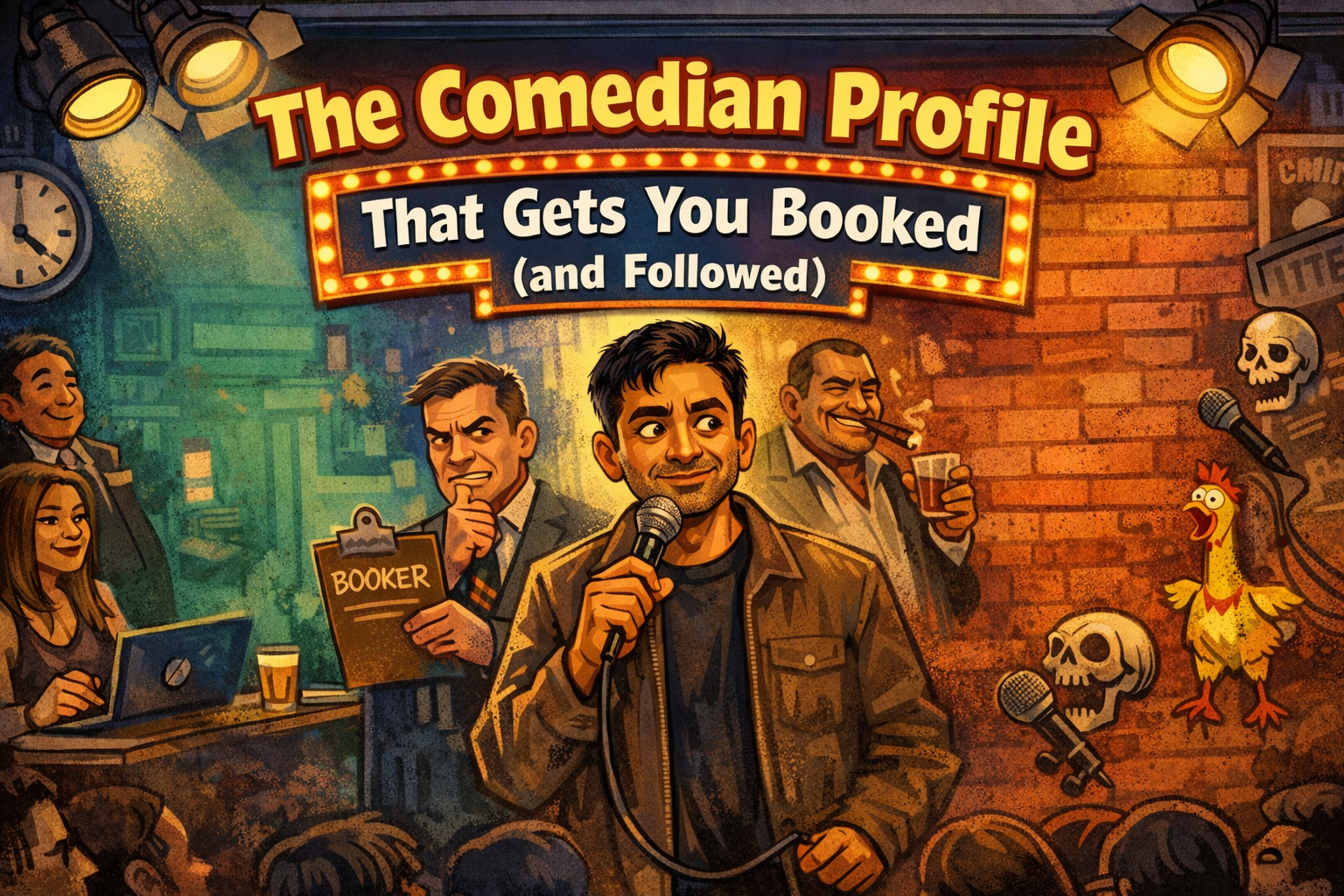
Most up-and-coming comics treat their profile like an afterthought. Bookers, producers, and audiences don’t. Your bio is the thing they paste into flyers, show listings, ticketing pages, and intros—often without asking you twice.
Nick Angelo (StandUpTix / New York Comedy Club) puts it plainly: a bad bio can hurt your “visibility and bookability.” (New York Comedy Club)
This post breaks down what to do, what not to do, and shows good/bad examples (including real patterns that working bookers say they see constantly).

What your “comedy profile” is (and isn’t)
Your profile is sales copy + clarity, not a stand-up set.
Sprout Social (used by a lot of working social media managers) calls a bio your “most basic elevator pitch”—a snapshot of who you are, what you do, and why someone should stick around. (Sprout Social)
New York Comedy Club’s advice is even sharper: “Don’t be funny.” Your jokes do the job onstage—your bio’s job is to make you easy to understand, search, and book. (New York Comedy Club)
DO: Build a profile that’s usable by other people
1) DO write a one-line logline anyone can repeat
Your first line should answer, instantly:
- Who are you?
- What kind of comic are you?
- Where are you based?
Good one-liner examples (real, public):
- PEN America’s John Mulaney bio leads with clear credibility: “two-time Emmy and WGA award-winning writer and comedian…” (PEN America)
- GQ’s Seinfeld Q&A shows a simple positioning statement right away: he’s “still doing stand-up” and the piece frames him as a working stand-up, not just a TV figure. (GQ)
Template (steal this):
[Name] is a [city]-based stand-up comedian known for [tone] jokes about [topics].
2) DO keep your “booking bio” to 4–6 sentences
This is one of the most repeated, practical guidelines from people who actually paste bios into ticketing systems.
New York Comedy Club recommends a paragraph—not two sentences, not your autobiography—roughly 4–6 sentences. (New York Comedy Club)
Why it works: it’s long enough to sell you, short enough to scan, and clean enough to copy/paste.
3) DO “roll credits” (even small ones—truthfully)
Angelo’s phrase is perfect: “Roll credits.” (New York Comedy Club)
Credits don’t have to be Netflix. They do have to be real and relevant, like:
- recurring host/producer of a show
- notable local venues/rooms
- festivals (accepted, semifinalist, etc.)
- podcast features
- writing/publication credits (if legit)
Good credit stacking example (real, public):
PEN’s John Mulaney profile lists recognizable proof points (SNL writing, specials, tours) in a clean, skimmable way. (PEN America)
4) DO make your profile searchable
Social media managers optimize for search because it’s free discovery.
Sprout Social explicitly recommends bios that support “credibility” and “searchability.” (Sprout Social)
And in their 2025 Instagram best-practices guidance, they call out using relevant keywords in your bio so you can show up in search. (Sprout Social)
Practical keyword ideas for comics:
- “stand-up comedian”
- your city (“NYC”, “Brooklyn”, “Toronto”)
- your lane (“dark”, “absurdist”, “clean”, “crowd work”, “storytelling”)
- your community lane if relevant (“Bangladeshi-American”, “queer”, “immigrant”)
5) DO include a clear next step (CTA + one link)
Sprout Social’s playbook: a bio should tell people what you offer and why they should follow—then give them a path forward. (Sprout Social)
Good CTAs for comedians:
- “Tickets ↓”
- “Book me”
- “Tour dates”
- “Watch clips”
- “Join mailing list”
If you’re producing shows (like Laughing Lassi), the CTA can be: “Next show: [date] — tickets ↓” and rotate it weekly.
6) DO build a “real voice” (onstage), not a fake voice (in your bio)
Patton Oswalt’s Just for Laughs keynote is a reminder: “Content is king.” (thecomicscomic.com)
Translation for your profile: don’t hide behind vague hype. Say what you actually do, what you actually talk about, and what audiences actually feel.
DON’T: The mistakes that make bookers and fans bounce
1) DON’T try to be “quirky” in your bio
New York Comedy Club is blunt: “This isn’t a bit.” (New York Comedy Club)
Real-life “bad bio” patterns they call out:
- the “my mom would say…” joke
- pointing out you’re writing the bio yourself
- forcing creativity to seem “different” (New York Comedy Club)
Bad example (common pattern):
“My mom says I’m the funniest person alive. Anyway, here’s my bio that I’m writing…”
Why it fails: it’s a cliché, it tells me nothing, and it’s not usable for marketing.
2) DON’T write two sentences or twenty paragraphs
Angelo says two sentences is “no good,” and sending your entire autobiography is also a mistake. (New York Comedy Club)
Bad example (too short):
“Comedian. Vibes. Catch me outside.”
Bad example (too long):
A life story that starts in childhood and never reaches what you do now.
3) DON’T be “weird to decode”
Clubs sell tickets with your bio. If your profile reads like a riddle, you’re making it harder for them to pay you.
NYCC’s guidance: don’t make people “use the Fibonacci scale to decipher your bio.” (New York Comedy Club)
Bad example (cryptic):
“A chaos merchant from the fourth dimension. Ask me about watermelons.”
If that’s your act, fine—but you still need plain English somewhere.
4) DON’T inflate credits (you will get caught)
If you’re “featured on” something, be sure that’s real. Bookers cross-check quickly.
Safe rule: if it’s not something you’d comfortably send to a producer who can verify it in 30 seconds, don’t put it in.
The 3 profiles you should maintain (with examples)
A) The Social Bio (Instagram/TikTok) — 150 characters
Goal: clarity + keywords + CTA.
Good example (format, not a specific person):
Stand-up comedian (NYC) • absurd/dark • immigrant stories + crowd work • 🎟️ tickets ↓
This aligns with Sprout Social’s “elevator pitch” + searchability + clear purpose. (Sprout Social)
B) The Booking Bio (show listings) — 4–6 sentences
Good example traits (as NYCC recommends): clear, normal formatting, credits included, not trying to be funny. (New York Comedy Club)
Template you can paste and fill:
[Name] is a [city]-based stand-up comedian whose comedy blends [tone] with [point of view], taking on [topics]. [He/She/They] has performed at [venues/rooms] and has been featured on [podcasts/shows]. [One sentence: background that explains POV]. [One sentence: current project—tour, monthly show, special taping]. Tickets and dates: [link].
C) The Artist / EPK Bio (website) — longer, but skimmable
Backstage’s EPK guidance: your bio is where you share personality and relevant background (training, skills, etc.) without turning it into a novel. (Backstage)
Add-ons for EPK:
- high-quality photos
- short clips
- press quotes (later)
- contact/booking info (email / agent if you have one)
Real “good vs bad” mini case studies
Case Study 1: The “copy/paste friendly” pro bio
Why it’s good: direct credibility + easy to republish + dense with proof points.
Example: PEN America’s John Mulaney profile starts with awards/role and then expands into specific credits in clean paragraphs. (PEN America)
Takeaway for amateurs: your version can be “NYC-based stand-up + produces monthly show + has performed at X rooms + featured on Y podcast.”
Case Study 2: The “booker warning label” bio
Why it’s bad: cliché humor, not informative, not sellable.
Example pattern called out by NYCC: “what your ‘mom would say’” and “drawing attention” to writing your own bio. (New York Comedy Club)
Takeaway: save the jokes for the stage. Your bio is for clarity.
A quick checklist before you publish
If you can answer “yes” to these, you’re ahead of most comics:
- First line says stand-up comedian + city + lane
- Booking bio is 4–6 sentences (New York Comedy Club)
- Includes real credits (“roll credits”) (New York Comedy Club)
- Includes keywords for search (Sprout Social)
- Has one clear CTA + link
- Not a riddle / not trying to be “different” for no reason (New York Comedy Club)
This content was created with the assistance of AI tools and reviewed by a human.