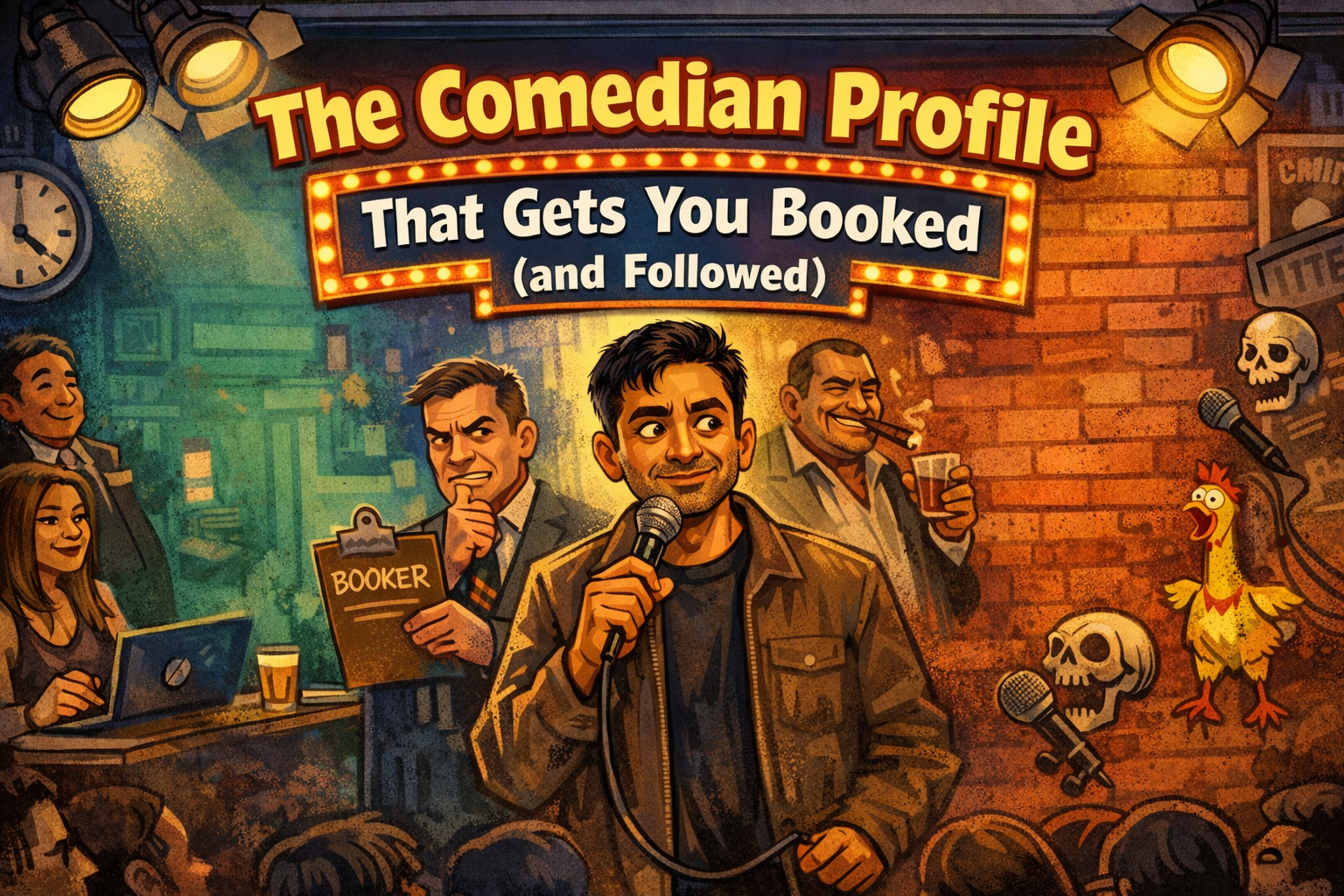
A festival producer’s honest guide to what actually gets you selected — and what immediately gets you skipped. By the producers of Laughing Lassi & the NYC South Asian Comedy Festival.
I’ve been on both sides of this. I’ve submitted to festivals as a comedian, and I’ve been on the other side reviewing submissions. After going through hundreds of them, the same mistakes come up over and over again.
Most comedians submit and hope for the best. The ones who actually get selected do something different — they approach the submission like a professional, not like someone crossing their fingers.
This is everything I wish someone had told me before I submitted to my first festival.
Before anything else — read the instructions
This sounds obvious. It shouldn’t need to be said. And yet.
Festival producers are going through hundreds of submissions, often on their own time. When a comedian doesn’t follow the instructions — submits the wrong format, the wrong length, the wrong link — it creates extra work. And that is never a good first impression.
If they ask for a 5-minute YouTube link, don’t send five Instagram clips and ask them to figure it out. If they ask for a bio under 150 words, don’t paste in your full press kit. If there’s a fee, pay it through the process they described.
Following instructions is not a low bar. For a surprising number of applicants, it is the first place they fail.
Choose the right set — this is harder than it sounds
Most comedians with a few years of performing have multiple clips. The question they almost never ask themselves seriously is: which one actually represents me best for this festival?
It’s not always your most recent set. It’s not always your longest or your most crowd-pleasing. The right clip is the one that shows your personality, your writing range, your stage presence, and your unique point of view — all in the time they gave you.
Ask yourself before you pick a clip
Does this set show who I am, or just what I can do in a good room? Would a producer watching this clip understand my voice within the first ninety seconds? Does it show more than one gear — more than one type of joke, more than one emotion?
A set that kills in a packed club on a Friday night is not automatically the right submission. Crowd energy can carry a mediocre set. Producers know this. They’re watching for what’s in you, not what the audience gave you.
Edit the clip like you mean it
If they want five minutes, give them five tight minutes. Not five minutes padded with a two-minute intro. Not seven minutes with the best five buried in the middle.
Cut the tape so it starts exactly where your first joke starts. Not when you walk up to the mic. Not when you say “how’s everyone doing tonight.” The first joke.
End it at the requested length, cleanly. Don’t let it drift.
Producers reviewing twenty or thirty clips in a session are not sitting there patiently. If nothing is happening in the first thirty seconds, they move on. Your best material in minute four doesn’t matter if they’ve already closed the tab.
“Producers are not just listening for jokes. They’re asking: would I trust this person on my stage in front of my audience?”
Audio and video quality are not optional
You don’t need a film crew. You do need the audience to be able to hear you clearly, see you properly, and not have the sound distort every time the room laughs.
Bad audio is an instant disadvantage. A reviewer can’t judge what they can’t hear. It doesn’t matter how strong the material is — if the recording makes it hard to evaluate, it’s easy to skip.
If you don’t have a clean recording yet, wait. Keep performing, find a show with a good sound system and a camera, and submit when you have something worth submitting. Rushing a weak tape to meet a deadline is how you waste a submission fee.
Show your writing, not just your crowd work
Crowd work is a skill. Some great comedians make it the center of their act. But if your submission clip is mostly crowd interaction and audience reaction, producers are left with one question: can this person actually write a set?
Festivals want to know you can deliver regardless of room energy. A quiet Tuesday crowd, a half-full early show, a room that’s warmed up for someone else — you’ll perform in all of these. Show them you can land in any of those situations.
There’s a difference between edgy and lazy. If your set opens with you calling the audience “assholes” for a cheap reaction, or you spend the first two minutes disrespecting the venue or the host to get a rise out of the crowd — that’s not bold writing. That’s a shortcut. And producers can tell the difference. If that’s how your submission clip starts, there’s a good chance the review ends right there.
The same goes for sets where every punchline lands on the same profanity or the same shock value. It’s not that those words are off-limits. It’s that if that’s all you have, it tells a producer something about your range as a writer — and it’s not a good look. Festival lineups are built to hold up for an entire audience across an entire show. One comedian who needs shock to survive every punchline is a risk most producers won’t take.
Beyond that — every comedian submitting is trying to be funny. That’s not what separates the submissions that get selected. What separates them is voice. Perspective. A way of looking at something that feels genuinely original. A producer building a lineup is asking: what does this comedian bring that nobody else on this list brings?
If your set sounds interchangeable with fifteen other submissions in the pile, it becomes very hard to justify a spot for you specifically.
Write a bio that actually helps you
Most comedian bios are either too long, too vague, or read like a LinkedIn profile. None of those are useful to a producer.
A good bio does three things: it tells them who you are as a comedian, gives them a few real, verifiable credits, and gives them a sense of your personality — because your personality on paper should match what they see on stage.
What to include
Years performing. Real, notable credits — festivals, clubs, shows, touring — that mean something. One or two sentences about your comedic voice or what makes your perspective different. Keep it under 150 words unless they ask for more.
What to leave out: exaggerated credits, things that aren’t verifiable, anything that makes you sound like you’re trying too hard to impress someone.
The people reading these bios have seen thousands of them. They know the difference between a credit that matters and one that’s being inflated. Be accurate. Be specific. Be brief.
Stage presence is part of the evaluation
A lot of comedians think the submission is purely about the material. It’s not. Producers are watching you the whole time the clip is running.
They’re watching how you carry yourself. How you handle silence. Whether you look like you belong on a stage or like you’re hoping no one notices you’re nervous. They’re watching your energy consistency — whether you’re the same performer at the start of the clip as you are at the end.
This matters because festivals are not just booking jokes. They’re booking a person who will stand in front of their audience and represent their event. One low-energy or nervous performance can shift the entire mood of a show. Producers are building something carefully, and they’re trying to minimize risk.
Unless your whole persona is intentionally awkward or introverted — and the audience response shows it’s clearly working — they want to see someone who looks comfortable up there.
Research the festival before you apply
One of the most avoidable mistakes I see is comedians submitting to every open call they find without doing any homework. That’s not a strategy. That’s hoping.
Look at the last two or three years of lineups. Not one year — multiple years, because patterns take more than one year to show up clearly.
What to look for in past lineups
What career stage are most of the comedians at? What styles tend to repeat — club comics, alt comics, storytellers, political comics? Are they booking mostly local talent or touring acts? Do they tend toward established names or emerging voices?
Ask yourself honestly: do I fit here? Not “could I perform here” — do I fit the programming pattern this festival has shown over time?
If the answer is probably not, save your submission fee and find a festival that’s a better match. There are more festivals than most comedians realize, and a realistic shot at the right one is worth more than a long shot at the wrong one.
Understand that festivals build lineups, not rankings
The biggest misconception about festival selection is that it’s a pure talent competition — that the funniest submissions get the spots.
That’s not how it works.
Producers are building a show. They’re thinking about flow, pacing, variety, audience experience, and how one comedian lands relative to the one before them and the one after. They’re balancing experience levels, styles, perspectives, and energy types all at the same time.
That means a great submission sometimes doesn’t get selected because the lineup already has two comedians with a similar voice, or because the show needs a different kind of energy in that slot, or because the festival is trying to represent a range that your specific submission doesn’t help them achieve.
That is not a judgment on your talent. It’s programming. The sooner you understand that distinction, the less personal you’ll take each rejection — and the more clearly you’ll be able to look at your submission and figure out what to actually improve.
They will look you up — make sure what they find helps you
If a producer is seriously considering you, there’s a very good chance they’re going to look at your social media. Not necessarily to judge your follower count — but to see if you’re actually doing this.
Your online presence doesn’t need to be exclusively comedy. But if a producer goes to your Instagram and sees no evidence that you perform stand-up — no clips, no show announcements, no anything that shows you work at this — it raises a question about how seriously you’re treating it.
Look at comedians you respect and study how they present themselves online. Use a real photo and your name on every platform. Make sure the version of you that shows up in a Google search looks like a comedian who takes their craft seriously.
Social media is not going to get you selected on its own. But a social media presence that contradicts your submission can quietly work against you.
How to handle rejection like a professional
Good comedians get rejected from festivals. Every year. That’s not a motivational statement — it’s just math. The number of applicants is always larger than the number of spots, and selection involves factors that have nothing to do with how funny you are.
What separates professionals from everyone else is what they do with it.
What to actually do after a rejection
If the festival allows it, follow up once — briefly, professionally, thanking them for the consideration and asking if there’s feedback available. Most won’t provide detailed notes, but some will, and a polite follow-up keeps the door open for the next cycle.
Look at your submission critically. Was the clip the best representation of your work? Was the audio quality strong? Did your bio clearly communicate your voice? Treat the rejection as data, not a verdict.
Apply again next year. Producers notice when comedians keep showing up and improving. Persistence, when it’s paired with actual growth, is something people in this industry remember.
A rejection from one festival in one year is one decision in one cycle. It is not a final answer about who you are as a comedian.
Final thought
The best submissions I’ve seen over the years all have something in common. They followed the instructions. The clip was clean and well-edited. The material showed a genuine, original voice. The performer looked like they belonged on a stage. And the whole package — video, bio, credits — communicated that this is someone who takes their craft seriously.
That’s what producers are ultimately asking when they go through a submission pile: can I trust this person on my stage? Will they make the show better?
Make the answer easy.
Further reading
These are the books most consistently recommended by working comedians and comedy educators. If you’re serious about the craft, these belong on your shelf.
The New Comedy Bible
Judy Carter
The closest thing the stand-up world has to a standard textbook. Carter breaks down joke structure, attitude, persona, and performance with specific, actionable exercises. Endorsed by Maz Jobrani, Sherri Shepherd, and Lily Tomlin among others. If you only read one book on writing stand-up, this is it.
Mastering Stand-Up: The Complete Guide to Becoming a Successful Comedian
Stephen Rosenfield
Rosenfield founded the American Comedy Institute and was called “probably the best known comedy teacher in the country” by the New York Times. His alumni include Jim Gaffigan and Jessica Kirson. This book covers setup and punchline construction, stage presence, and the business of building a comedy career. Complements the Comedy Bible by approaching joke mechanics from a different angle.
Born Standing Up: A Comic’s Life
Steve Martin
Not a how-to guide — a memoir. Jerry Seinfeld called it “absolutely magnificent. One of the best books about comedy and being a comedian ever written.” Martin chronicles the decade of grinding, experimenting, and failing that preceded his sudden explosion onto the national scene. Required reading for understanding what the long game actually looks like.
Sick in the Head: Conversations About Life and Comedy
Judd Apatow
A collection of interviews Apatow conducted over thirty years — starting when he was a teenager with a tape recorder — with comedians including Mel Brooks, Jerry Seinfeld, Sarah Silverman, and Chris Rock. Less about technique and more about how comedians think: about their work, their influences, and why they do this at all. Valuable for perspective more than craft.
Impro: Improvisation and the Theatre
Keith Johnstone
Not a stand-up book — it’s about improvisation and theatrical instinct. But it’s been quietly influential on how comedians think about spontaneity, status, and presence. If you’ve ever felt stiff or calculated on stage, Johnstone’s ideas about freeing yourself from self-censorship are worth the read. Widely referenced in comedy circles even though it was never written for stand-ups.